Perfect Preparation for Turfgrass Diseases! Smart Control Driven by Data
February 10, 2026
Perfect Preparation for Turfgrass Diseases! Smart Control Driven by Data
Hello. We are MeissaGreen, your IT partner driving smart transformations in golf course management.
The season for "turfgrass diseases"—the uninvited guests on your greens—is fast approaching. Once they begin to spread, they can quickly deteriorate course quality, making this the most stressful time of year for Course Superintendents.
Recently, due to abnormal climate conditions, traditional disease outbreak timelines have become distorted. This has led to frequent unexpected situations that are difficult to predict relying solely on the invaluable experience and intuition Superintendents have built over decades. General Managers and CEOs are also likely deeply concerned about how to efficiently resolve these issues, as declining course quality directly leads to customer complaints.
Today, we will review the characteristics of major golf course diseases and introduce a method to secure the perfect prevention timing—without the need for excessive overtime—by combining your Superintendent's experience with MeissaGreen's data!
Why do illnesses recur? — Understanding the disease triangle
Grass diseases such as mold 'pathogens', hot and humid 'environment', and the stress of grass 'host' It explosively occurs when a condition triplets. In particular, the rainy season and heat waves in Korea provide an optimal environment for pathogens to proliferate.
The problem is that due to climate change, fatal diseases such as spring large patches and summer phisium blight are occurring earlier or more irregular than usual. Ultimately, the key lies in “the timing of detecting minor changes and applying preventive reagents one step ahead of time before the disease becomes serious with the naked eye.”
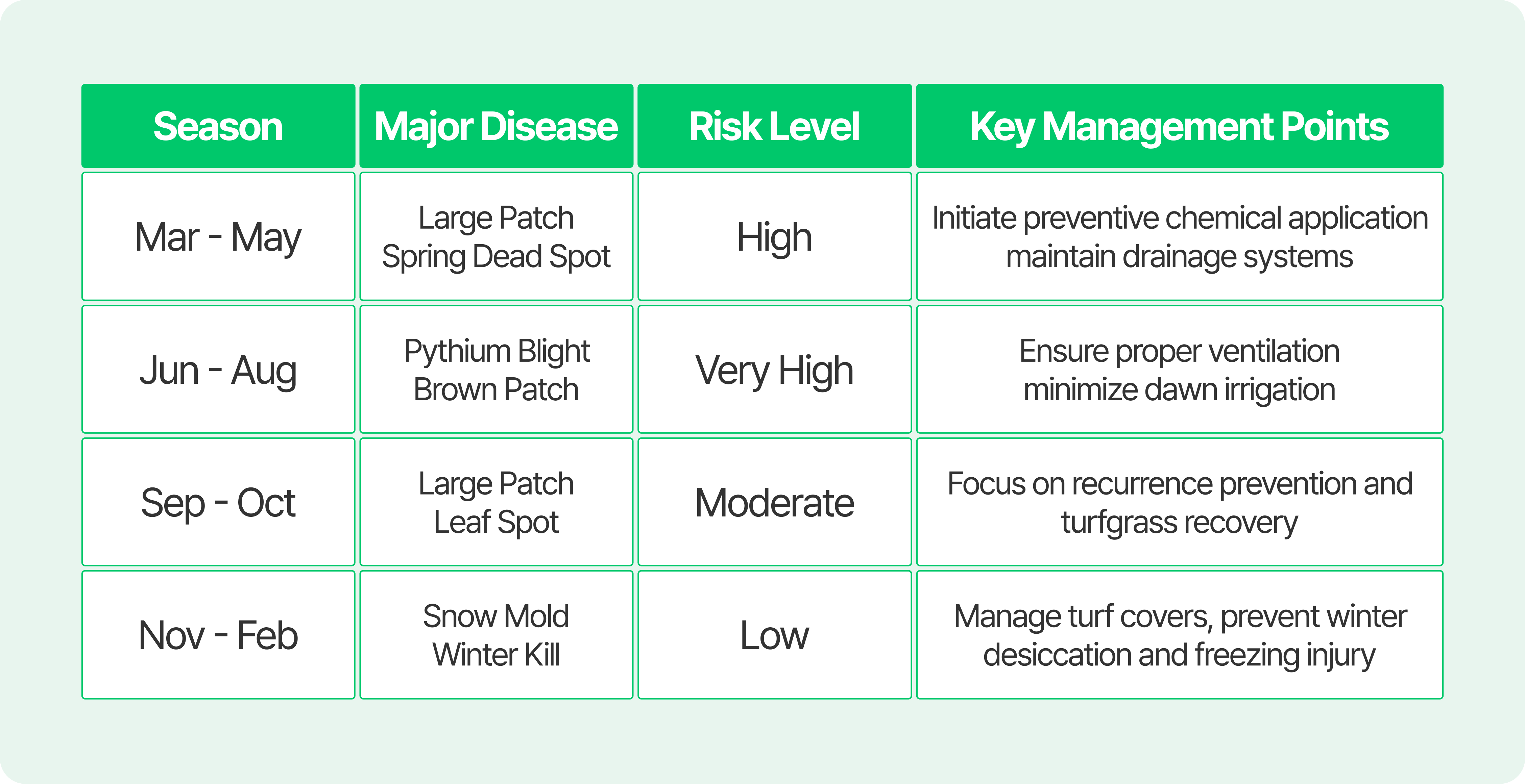
Seasonal Occurrence of Major Diseases
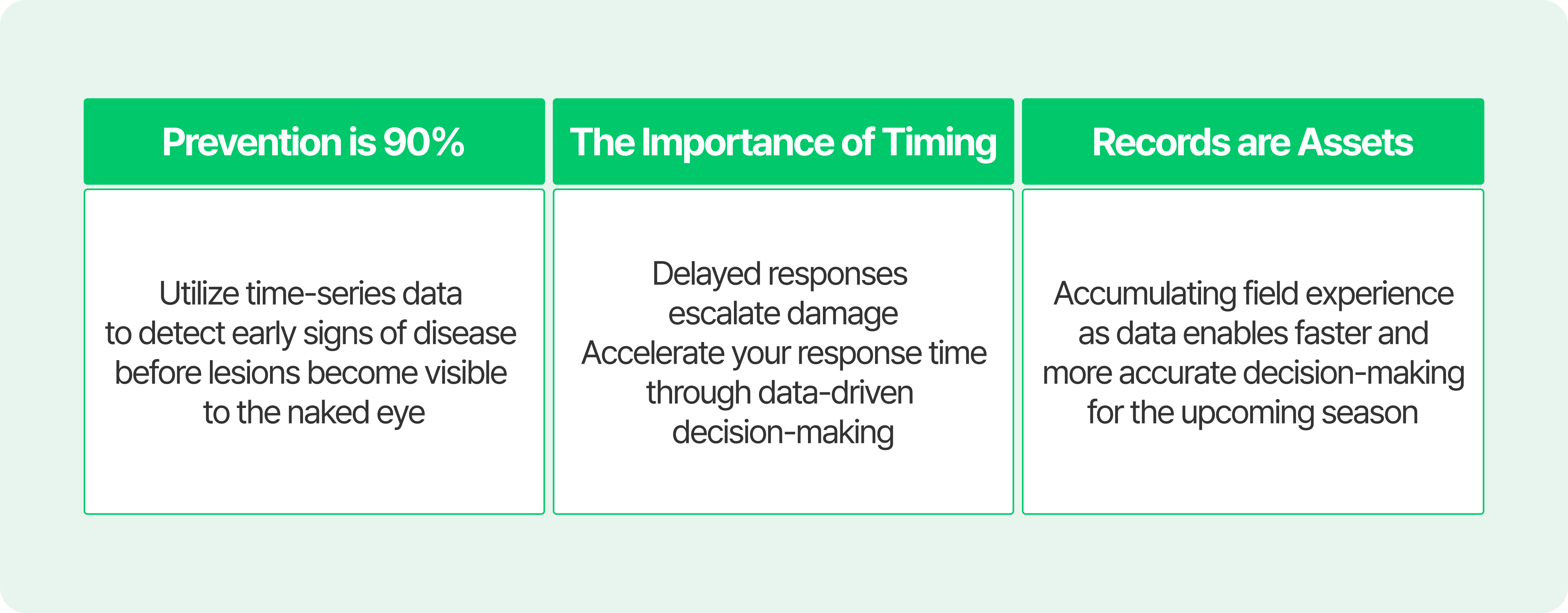
Due to extreme weather events in 2025, we are seeing an increase in cases where traditional outbreak periods are advancing. By utilizing time-series data alongside past experience, you can pinpoint your prevention timing with much greater accuracy.
Comprehensive Guide to Major Turfgrass Diseases
Large Patch
Type: Zoysiagrass / Spring & Fall / Root Rot
Characteristics & Conditions: Occurs in spring and fall at 15~30°C, typically in poorly drained or shaded areas. The roots, rather than the leaves, rot, spreading in a "doughnut" shape.
Prevention & Response: Preventive fungicide application in April-May is essential! If an outbreak occurs, apply a drench treatment to reach the roots, and do not forget to maintain drainage systems in the spring.
💡 MeissaGreen Tip: By visualizing the spread on a map using drones, you can detect early lesions that are easily missed by the naked eye.
Pythium Blight
Type: Summer / High Temp & Humidity / Rapid Spread
Characteristics & Conditions: Spreads explosively during the hot and humid rainy season in July-August, especially with excessive nitrogen. White mycelium appears in morning dew, and it spreads incredibly fast.
Prevention & Response: Periodic preventive applications starting in June and minimizing dawn irrigation. Immediate action within 24 hours of an outbreak is critical.
💡 MeissaGreen Tip: Capture and log signs of an outbreak instantly on-site using our mobile app. Managers can check it in real-time from the office and rapidly share it with the entire team.
Brown Patch
Type: Bentgrass / Summer / Circular Brown Spots
Characteristics & Conditions: Occurs in the hot, humid summer at 20~30°C. It is characterized by circular brown spots with a distinct "smoke ring" around the edges.
Prevention & Response: Apply preventive fungicides, use blowers to remove morning dew, and avoid excessive nitrogen fertilization.
💡 MeissaGreen Tip: Track disease pattern trends on our hole-by-hole dashboard and detect anomalies early by comparing them with the green conditions from the exact same period in previous years.
Anthracnose
Type: Stress-induced / Summer / Stolon Necrosis
Characteristics & Conditions: When turf stamina drops due to high temperatures, excessive mowing, or heavy traffic, stems turn black and rot, and leaf tips dry out.
Prevention & Response: Minimizing stress is the answer. Raise the mowing height, restrict cart/foot traffic, and remove clippings immediately.
💡 MeissaGreen Tip: Identify holes with declining time-series health indices in advance and designate them as intensive stress management zones.
Summer Patch
Type: Root Necrosis / Summer / Prevention is Key
Characteristics & Conditions: Occurs when summer soil temperatures rise and drainage is poor. Roots rot and turn black, making recovery extremely difficult and often requiring reseeding.
Prevention & Response: Prevention over cure! Create a breathable environment for roots through proactive fungicide applications, soil pH adjustments, and aeration.
💡 MeissaGreen Tip: Analyze chlorophyll density using a multispectral sensor drone to detect signs of root stress before they become visible.
The Difference Data Makes When Combined with Experience
Turfgrass disease management is an area where the expertise and field experience of the course management team truly shine. Decades of refined intuition cannot be replaced by any system.
What MeissaGreen does is add "data" to that experience. High-resolution course images captured daily by drones, accumulated turf health indices by date, and comprehensive logs of operations and chemical applications. This data supports the Superintendent's decisions and accelerates the entire team's response time. MeissaGreen will be with you to ensure your course management team can work more efficiently and make decisions rooted in solid evidence.
💬 Curious about Meisa Green?
Explore the demo: What if you want to know Meisa Green intuitively? [here]You can check it out at
Implementation inquiries: If you need a customized consultation for our golf course environment [here]Please contact us at
Get regular news: If you want to be the first to hear about new feature releases, Meisa Green's [Subscribe to our newsletter]Please do it.

%201.png)


%201.png)
%201.png)
%201.png)
%201.png)