

Turfgrass doesn't speak. However, Course Superintendents—who have sweated in the field for decades—can read the SOS signals sent by the turf earlier than anyone else, just by noticing a slight desiccation at the leaf tips or a subtly faded color. That sharp intuition and experience form the solid foundation of perfect course management.
For turfgrass to maintain optimal health, it requires a balanced supply of 17 essential elements. A deficiency in even one of these will trigger immediate abnormal symptoms. The problem is that these nutrient deficiency symptoms often closely mimic damage from diseases or pests, which can cloud judgment.
Today, to ease the burden on course management teams, MeissaGreen has compiled a checklist of the 17 essential elements and a data-driven smart diagnostic method to back up the extensive experience and intuition of our Superintendents.

The essential elements indispensable for turfgrass growth are broadly divided into three groups based on the required amount.
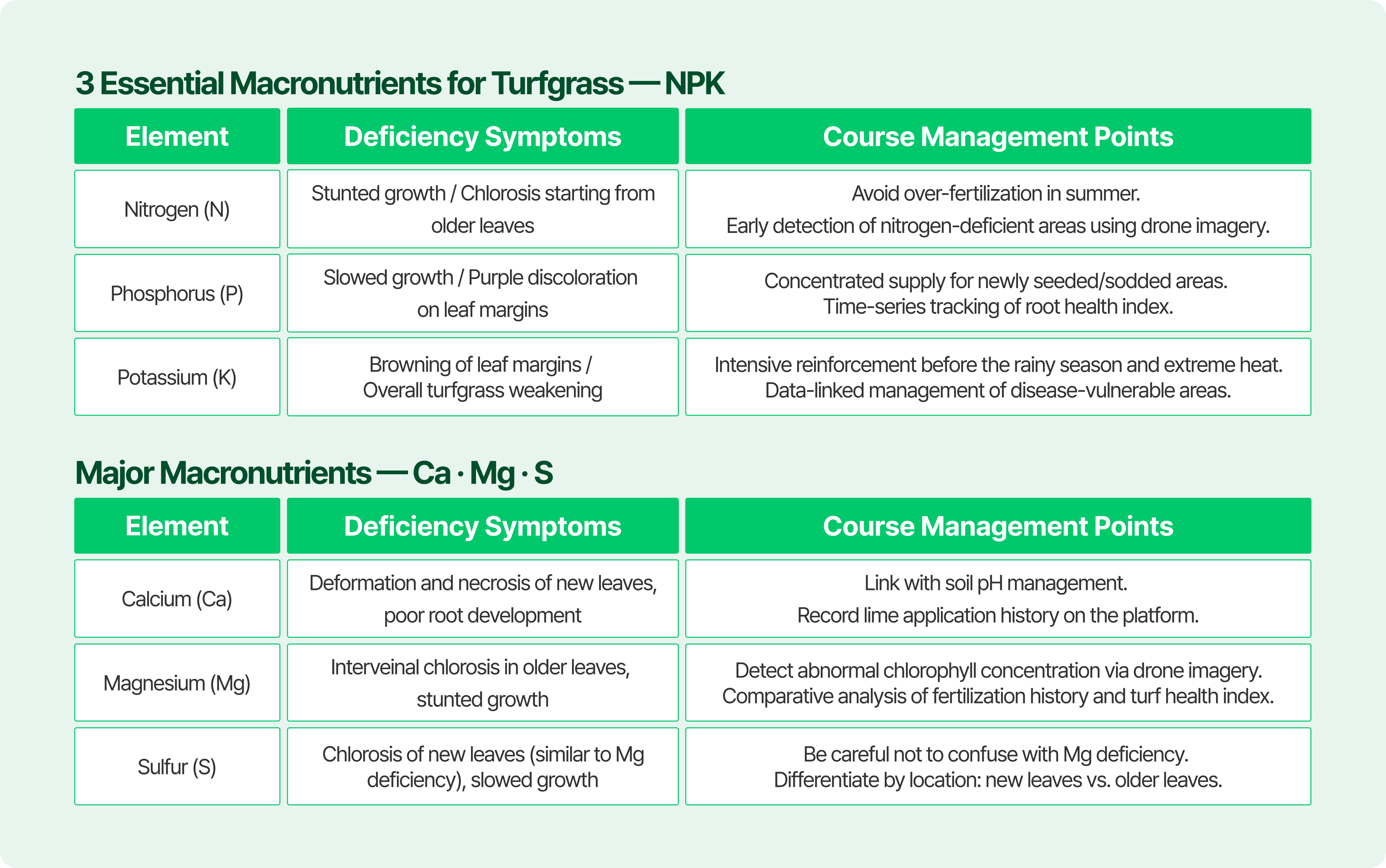
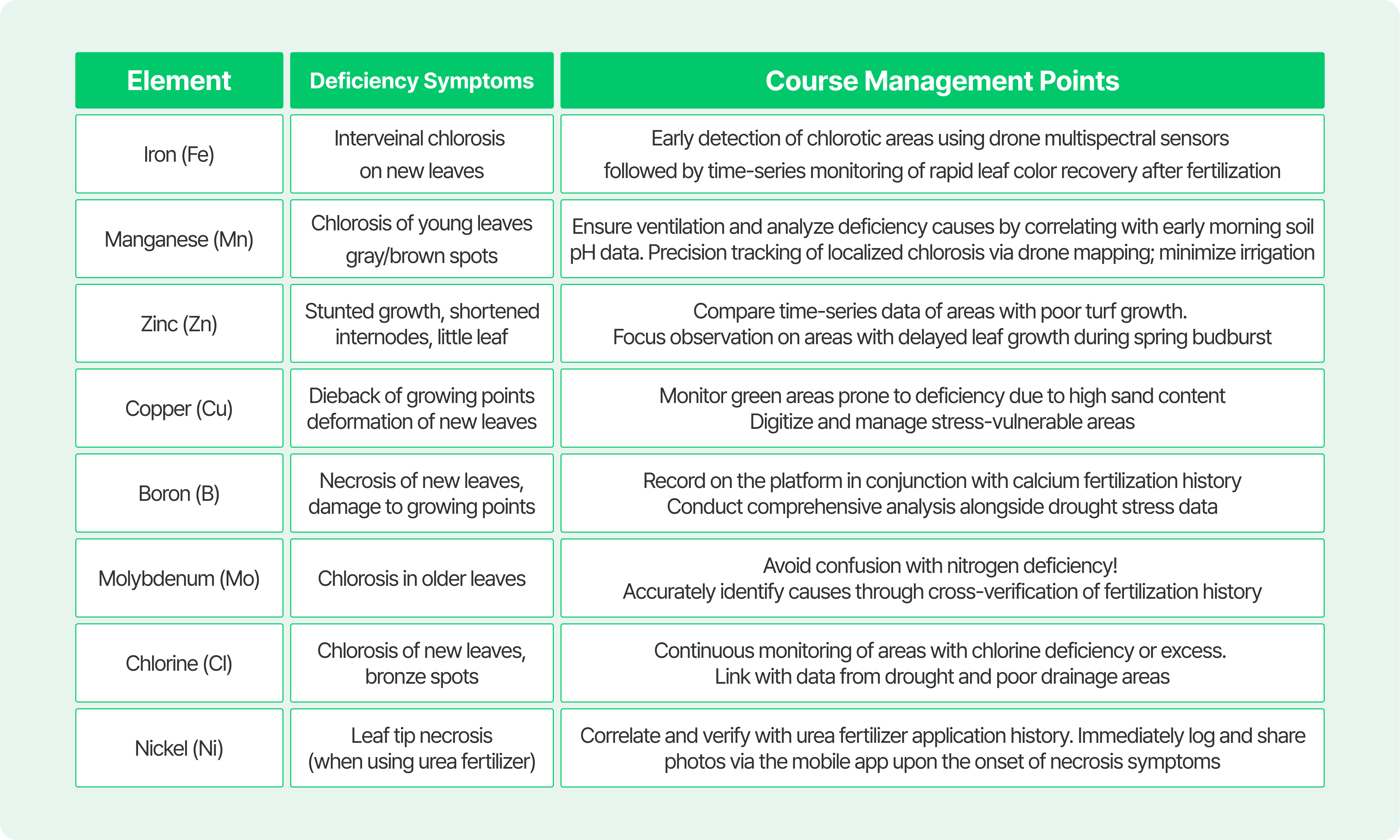
Nutrient deficiencies can easily be mistaken for pest or disease damage, leading to unnecessary pesticide applications. We looked at three classification criteria that Superintendents intuitively use in the field, from a data perspective.
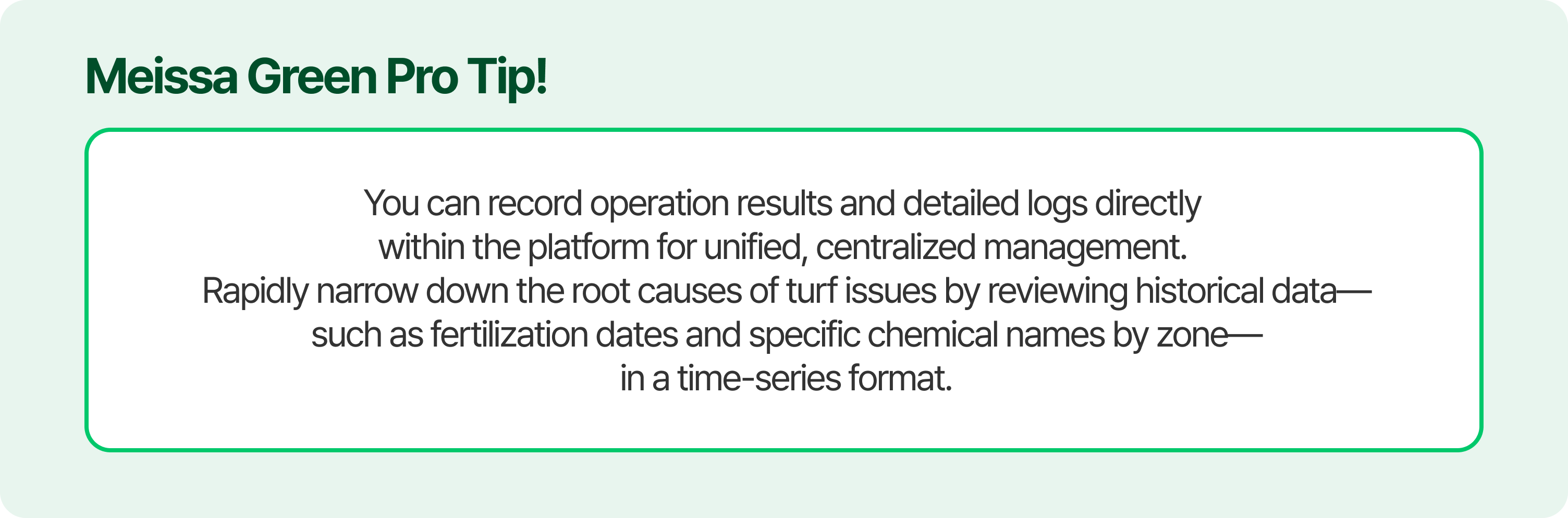
The inherent limitation of traditional visual diagnosis is that "by the time symptoms are visible to the human eye, it is often already too late." MeissaGreen accelerates and predicts this diagnostic process by regularly mapping the entire golf course. When MeissaGreen's data is combined with the Superintendent's sharp field intuition, an "Ultra-Precision Fertilization Plan" is achieved—reducing unnecessary fertilizer waste while maximizing course quality.
Q.I suspect a nutrient deficiency. Can I apply fertilizer immediately without a soil test?
A.In an emergency, you can take preliminary action based on the Superintendent's experience. However, blind fertilization can cause an 'antagonistic effect,' where an excess of one element blocks the absorption of another. It is most efficient to establish a baseline with a pre-season soil test and use drone vegetation data as a supplementary indicator. If it's an emergency, you can take priority action based on the team leader's experience. However, vague fertilization can cause an excess of a specific element and cause an “antagonistic effect” that interferes with the absorption of other elements. It is most efficient to set a baseline with pre-season soil testing and use drone vegetation data as an auxiliary indicator.
Q. What problems occur if too much fertilizer is applied?
A. Supplying excessive nitrogen, especially during high summer temperatures, makes the turf tissue soft and highly vulnerable to lethal diseases like Brown Patch or Pythium Blight. We recommend adjusting application rates flexibly while monitoring trends in time-series health data.
Q. Magnesium (Mg) and Sulfur (S) deficiency symptoms look similar and are confusing.
A. The key is "which leaves do they start in?" Magnesium, which has high mobility, causes chlorosis starting in "older leaves," while Sulfur, which has low mobility, shows symptoms starting in "new leaves."
Q.If the person in charge changes, how do we grasp the detailed past fertilization history?
A. This is a chronic handover problem faced by many golf courses. MeissaGreen centrally manages detailed logs, including application dates, chemical names, targeted zones, and operators on the platform. Even if the personnel changes, the valuable course history is perfectly preserved, allowing the new manager to quickly understand the course characteristics based on data.
Turfgrass constantly sends signals, and hearing that subtle voice in time is the very core of course management. If the weapon of drone imagery and time-series data is added to the Superintendents' deep understanding of the 17 essential elements, abnormal climates or sudden variables will no longer be a threat.
Experience the miracle of turning experience into data to create a perfect course with MeissaGreen. We will work even harder to be the most reliable partner, saving our Superintendents from exhausting legwork and adding confidence to your intuitive judgments!