
%201.png)

The hottest topic in the construction industry right now is undoubtedly "AI adoption." Many sites are actively deploying intelligent solutions in step with the smart construction trend, aiming for better management and efficiency.
But once you actually apply advanced AI in the field, a familiar frustration tends to surface among practitioners: "It's impressive, but in the end I still have to check all the fine details myself." If you adopted AI hoping to put it to good use, yet it doesn't run as smoothly as expected or feels disconnected from real work, what is the reason?
It is not a problem with the AI's performance itself, but rather that the AI lacks the "context" it needs to properly understand your site. In this article, we want to talk about the "digital infrastructure" that must be in place on your site so you can use these solutions as freely as you want.

For AI to produce proper results, concrete "context" is essential. The problem is that the context of a construction site does not live in documents; it lives in the offline reality itself—the "space, time, and state" that change every day as earth is dug and structures are erected.
For AI to fully understand this site, every situation on the site must be fed in as digital data. In practice, however, that data is thoroughly fragmented. The Plan ("this is how we intended to build it"), the As-built ("this is how it was actually built"), and the Progress ("we've built this much, so please pay us") data are scattered across different systems and in the drawers of different people.
Painful rework breaks out because the design drawings and the actual construction locations differ, and every month draining disputes with partner companies flare up at progress-payment settlement time—all because everyone is looking at different data. As long as site records remain fragmented, even the most capable AI can only read fragmented past documents; it cannot pinpoint the real context the site needs right now.
To overcome this disconnect, the first thing you need is to build an SSOT (Single Source of Truth).
SSOT is not a grand concept. It means aligning the previously fragmented Plan, As-built, and Progress data in a single row on top of the same physical reference (XYZ coordinates). For a given space, it ties together what we designed, how it was actually built, and its current progress under one standard. When a time axis is added on top of this, clear time-series tracking of how that space has changed over time becomes possible.
Here we need to change our perspective on the construction site's "digital twin." If the digital twin has so far remained a novelty "3D viewer" that floats design drawings in three dimensions, it must now evolve into a new operating system that accumulates, day by day, which work was done in which zone yesterday and what changed. The digital twin must become the foundation of a "World Model" that AI can use to judge and act. Only when the owner, the general contractor, and the partner companies all share this single set of real-world data do today's disputes finally turn into objective fact-checking.
Once Plan, As-built, and Progress are aligned on a single reference, the scope and depth with which your adopted AI helps practitioners change completely.
%201.png)
In the past, opaque progress-payment disputes were frequent because calculations relied on the number of dump-truck dispatches or sampling surveys. But when the coordinates and quantities of completed zones are recorded as 3D data, the pain of manual tallying disappears. Through DTM (Digital Terrain Model) technology with centimeter-level accuracy, objective figures block settlement disputes between partner companies at the source.
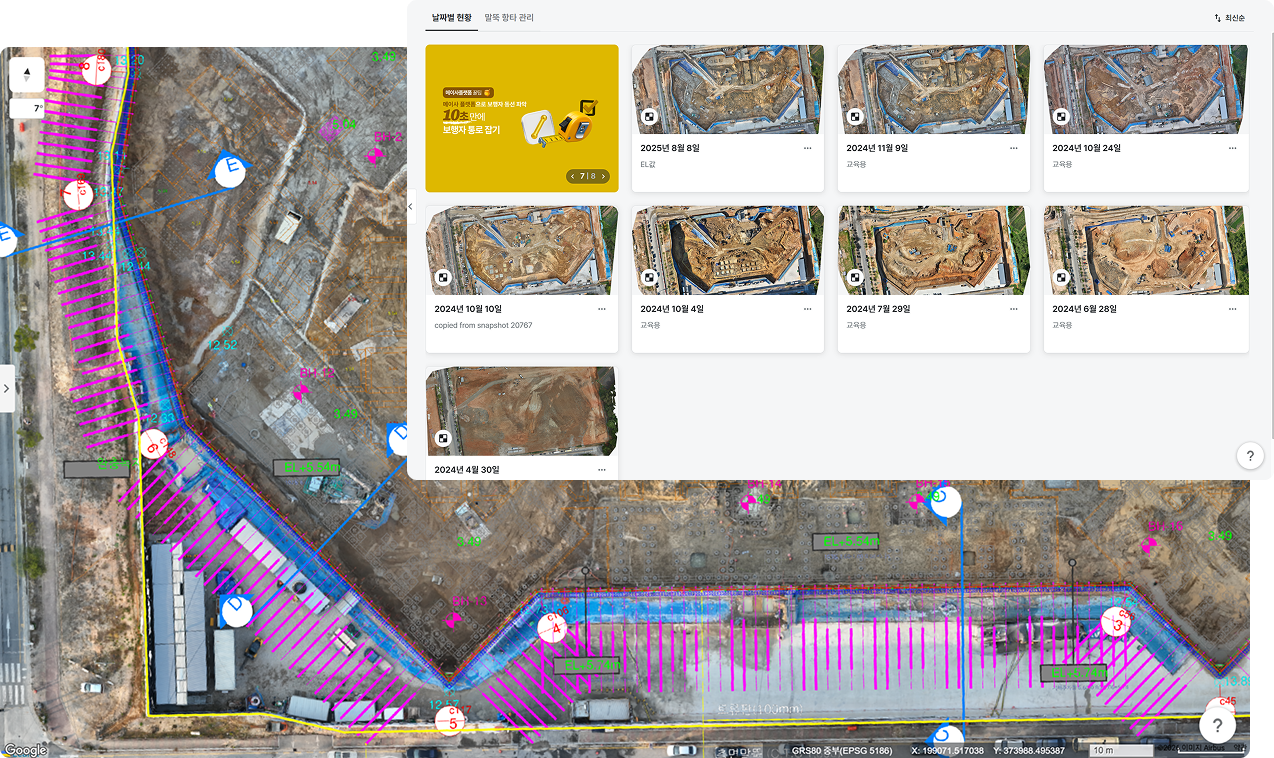
Discrepancies between the drawings and the actual on-site locations cause enormous rebuilding costs. Simply overlaying continuously updated drawings on top of the latest orthophoto or 3D model captured by drone lets you detect the risk of misplaced construction early—something hard to catch by having people walk and check every spot in person. It stops rework from snowballing before the concrete is even poured.

When construction data is linked to the design schedule, you can intuitively visualize actual progress against the plan and remove the uncertainty of schedule delays.
The one grand premise behind all of these changes is singular: Plan, construction, and progress must be firmly connected on top of a single physical reference.
True competitiveness in the AI era does not end with adopting a better reasoning model. It is completed by how well—and how accurately—you can convey to the AI the "context" of the demanding site that you know.
On a construction site, that context is precisely the SSOT that aligns Plan, As-built, and Progress data on a single reference. When this is in place on your site, AI can finally read the site's present state accurately, and from that point on, true automation and insight generate explosive synergy. Advancing your solutions is a story for after that foundation has been laid.
Meissa is the solution that fills exactly this empty context. Using drones and satellites, it collects data from wide, complex sites without human intervention and automatically converts it into precise 3D models. On top of that, it makes Plan, As-built, and Progress consistent on a single platform, becoming a powerful foundation so that the AI you have deployed on site can grasp the situation and function as intelligently as you expected.
If you want to use the AI solutions you've adopted as freely and completely as you wish, we invite you to build that unshakable data foundation together with Meissa.

