
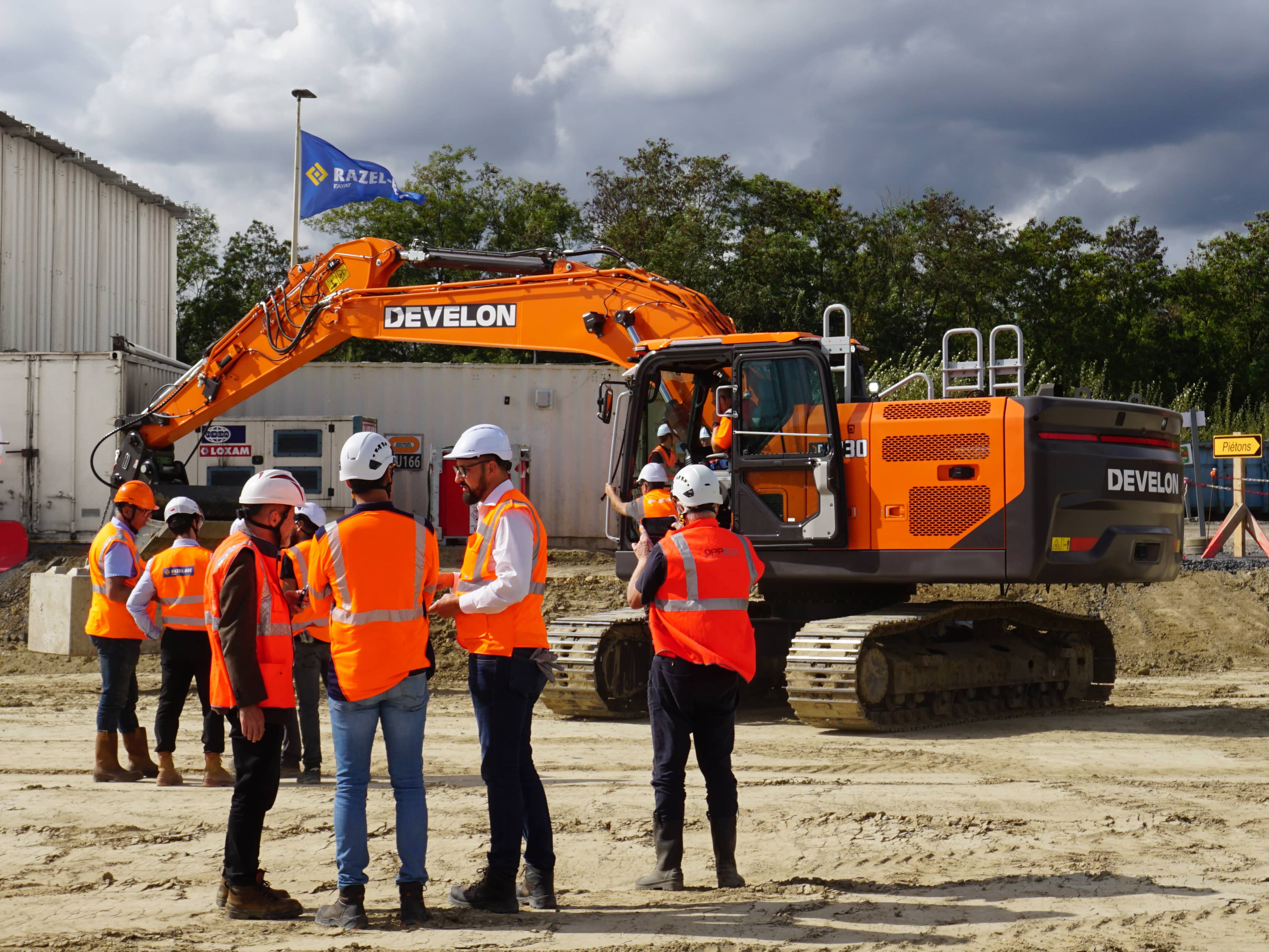
Two recent pieces of news signal meaningful changes in the technology and labor landscape of the construction industry. First, HD Hyundai Construction Equipment won Italy's SaMoTer Technical Innovation Award for 'E-STOP,' an AI-based automatic braking technology that recognizes people and stops equipment on its own. Second, just two months after the Yellow Envelope Law took effect, subcontractor unions at construction sites nationwide are ramping up demands to bargain directly with prime contractors (headquarters).
Although they appear to belong to entirely different domains—the adoption of advanced safety technology and the revision of the Trade Union Act—the two developments ultimately point in the same direction: the party holding real control over and responsibility for on-site 'safety' and 'labor' is shifting rapidly from individual sites or subcontractors to the 'construction company's headquarters.' With the July revision of the Construction Capability Evaluation set to tie safety and labor risks directly to a company's headquarters rating, calls are growing for firms to urgently review structural data integration across their site-management systems and beyond.
In this week's insight, we look at the background of these two developments and examine the limits of risk management faced by construction headquarters that must oversee hundreds of sites—and the need for an integrated data network.

HD Hyundai Construction Equipment's 'E-STOP (emergency automatic equipment braking technology),' which recently won Italy's SaMoTer Technical Innovation Award, is an AI smart safety system that uses cameras and radar sensors to detect people within the working radius in real time. In the past, safety accidents had to be prevented by relying on the heavy-equipment operator's field of view and reflexes, or on the control of an on-site signaler. Now, however, AI deep-learning technology precisely distinguishes objects from people and has entered a stage of 'autonomous control' in which the equipment slows or brakes on its own when a person is detected within the danger radius. This means that control over on-site safety has moved beyond human cognition into the data-processing domain of digital systems.
Alongside technological progress, a significant change has also occurred in the labor environment. With the enforcement of the revised Trade Union Act—the so-called 'Yellow Envelope Law'—prime contractors (headquarters) that exercise real, concrete control and influence over working conditions are now recognized as legal employers. As a result, at construction sites nationwide, subcontracted workers are increasingly demanding collective bargaining not with the subcontractors that directly signed their employment contracts, but with the prime construction companies that hold the real authority. As the boundaries of the law expand, headquarters now find themselves having to directly control and defend against the risks of labor disputes arising on site.
As safety equipment rapidly advances and responsibility for subcontracted labor concentrates at headquarters, the traditional site-centered management approach alone is becoming increasingly inadequate for fully responding to a fast-changing risk environment. Safety and labor risks, in particular, have now moved beyond mere disputes to become key indicators that determine a company's business competitiveness. Under the Ministry of Land, Infrastructure and Transport's revised Construction Capability Evaluation taking effect this July, the penalty points imposed for a guilty verdict under the Serious Accidents Punishment Act or for the occurrence of a safety accident have been sharply expanded. Conversely, the adoption of smart construction technology and exemplary safety management serve as bonus-point factors. In other words, a structure has formed in which whether AI equipment functioned properly on site to prevent an accident, and whether subcontracted workers' labor conditions were lawfully managed, merge into a single outcome: the Construction Capability Evaluation score and the ESG rating.
For construction headquarters that must be responsible for numerous sites simultaneously, however, the reality is that preparing for such integrated evaluation is no easy task. Vast amounts of data are continuously generated at every site, but because information is managed separately according to the characteristics of each site and department, consolidating and analyzing it company-wide when needed inevitably takes considerable physical time. The problem is not a lack of data but that it is scattered across individual sites—so when a serious accident is investigated or a union demands bargaining, structural difficulties arise in quickly proving the objective facts and improving systems proactively.
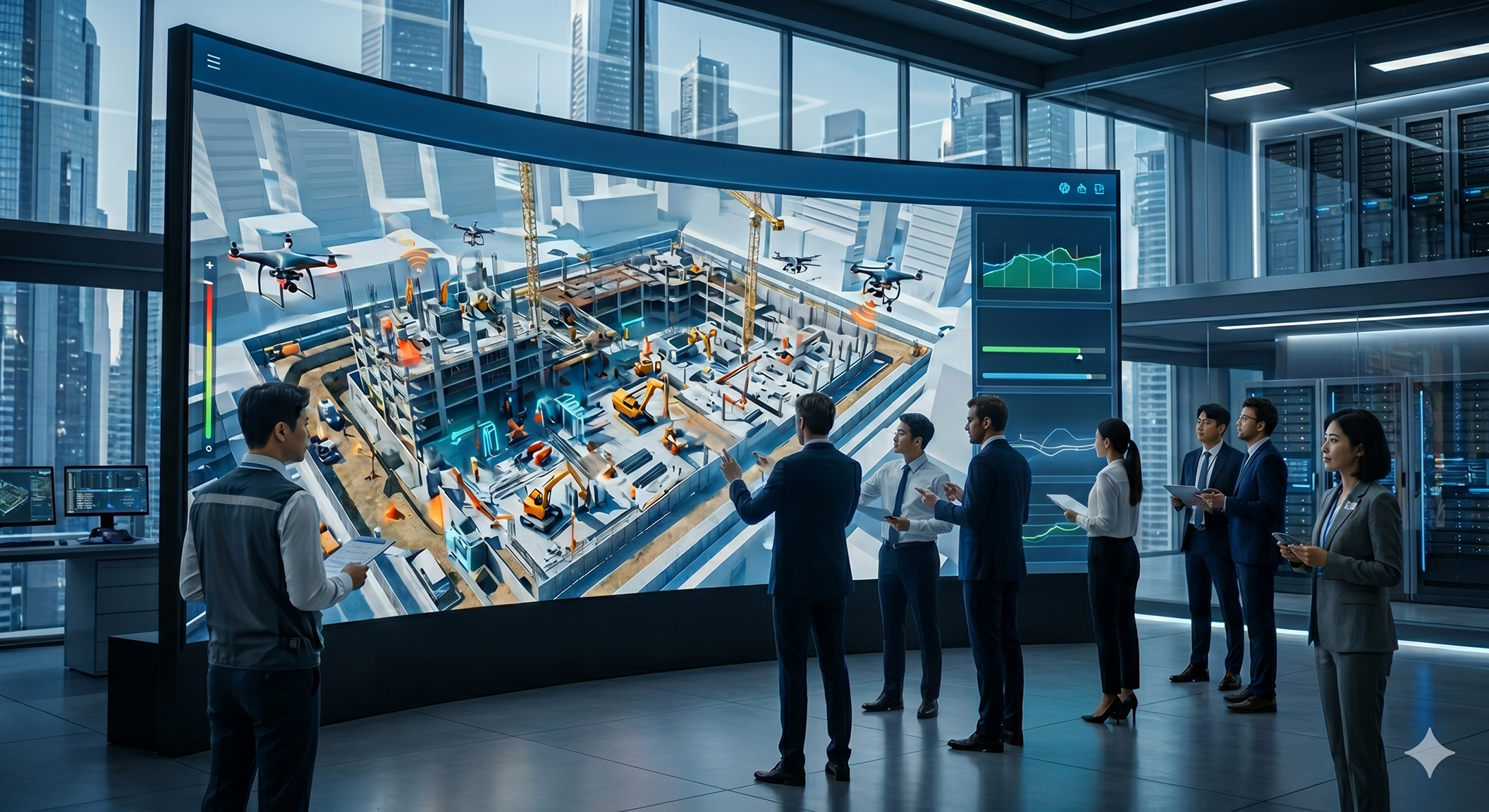
Experts agree that for construction headquarters to effectively manage site risk as a genuine integrated control tower, they must evolve beyond the existing after-the-fact consolidation approach toward an integrated system in which site data is organically connected. It is time to consider how the data network should develop so that the adoption of safety-system equipment, labor negotiations, and responses to the Construction Capability Evaluation can all be based on the same objective data.
Only by evolving toward a system in which fragmented, disconnected site information is integrated into a three-dimensional 3D space, the site's process flow is preserved in real time, and the system itself flags even the context of hazardous situations can companies respond flexibly and accurately to complex, compound risks. An era has arrived in which equipment detects danger and stops on its own, and regulation compels the prime contractor's direct responsibility. For the construction industry to prevent serious accidents and respond effectively to increasingly diverse labor risks, the moment has come when advancing the entire system—including establishing a consistent, headquarters-level data-control framework that goes beyond fragmented, department-by-department responses—is essential.

