Considering Drone-Based Safety Monitoring to Prepare for the Serious Accidents Punishment Act?
5 Checkpoints Worth Reviewing
With the Serious Accidents Punishment Act now fully expanded, the burden on job sites is greater than ever. In particular, as coverage now extends even to sites with construction costs below KRW 5 billion, the question of how to objectively prove that "preventive safety measures" were taken has become a core challenge for both site managers and management-level officers, regardless of project size. On site, safety watch teams are deployed to prevent frontline accidents, and managers personally walk the grounds to carry out inspections. But there are physical limits to having a finite workforce monitor sites spanning tens of thousands of pyeong and dangerous work-at-height zones seamlessly, 24 hours a day.
That is why the alternative construction firms have recently turned their attention to is "drone-based integrated safety monitoring." It regularly and automatically records even the blind spots beyond a manager's line of sight, and AI detects hazardous situations in real time. Above all, because every inspection record is automatically saved to the platform together with date, time, and location (GPS) information, it can serve as a reliable "digital shield" that objectively proves the site's diligence and accountability.
Yet when it comes time to actually adopt a new system, practical concerns come first. "Do we really need it at our site? Won't the adoption process be complicated? Won't it actually add to the workload of the people on the ground?" To ease these concerns for practitioners, Meissa has compiled 5 checkpoints you must review before adopting a smart safety monitoring system.
Check 1. Site Conditions — Scale, Work Type, and Schedule
Even with the same solution, the perceived value varies greatly depending on site conditions.
Scale: Adoption demand generally concentrates on large sites with construction costs of KRW 150 billion or more. Because such sites are so vast, it is hard to cover the physical blind spots with existing manpower alone. However, even a smaller site can gain ample value from adoption if it is concentrated with high-risk work types.
Work type: At a residential building site, the key priorities are work at height, inspection of exterior-wall safety nets, and detecting whether workers are wearing personal protective equipment (PPE). At a civil engineering site, on the other hand, priority goes to detecting whether personnel enter the working radius of heavy equipment across the large grounds.
Schedule: On long-term sites of 24 months or more, the value of turning data into a "time-series asset" truly shines. Data that periodically records the same location goes beyond simple safety inspection to serve as objective time-series evidence for managing progress and resolving disputes.
Check 2. Operating Environment — Airspace, Dock Installation, and Operator
Before bringing equipment onto the site, you need to understand the physical and organizational operating environment in advance.
Whether flight is permitted: You need to confirm whether the area is a no-fly or restricted zone, such as near airports or military facilities. If it is a restricted zone, a flight approval process must precede adoption.
Dock (drone station) installation requirements: Operating a Dock for full automation requires flat ground, stable power and communications, and a secure space for safe takeoff and landing. If conditions are not favorable, you can also start with manual piloting or an external professional pilot visit service (DaaS).
Setting the operator: You need to choose an operating model that fits your organizational structure—whether to build a company-wide standard safety management system at the headquarters level, or to improve the efficiency of a single site.
Check 3. Feature Requirements — At Least 3 Essentials for Serious Accidents Punishment Act Compliance
To achieve the goal of complying with the Serious Accidents Punishment Act, the following 3 requirements must be met without fail.
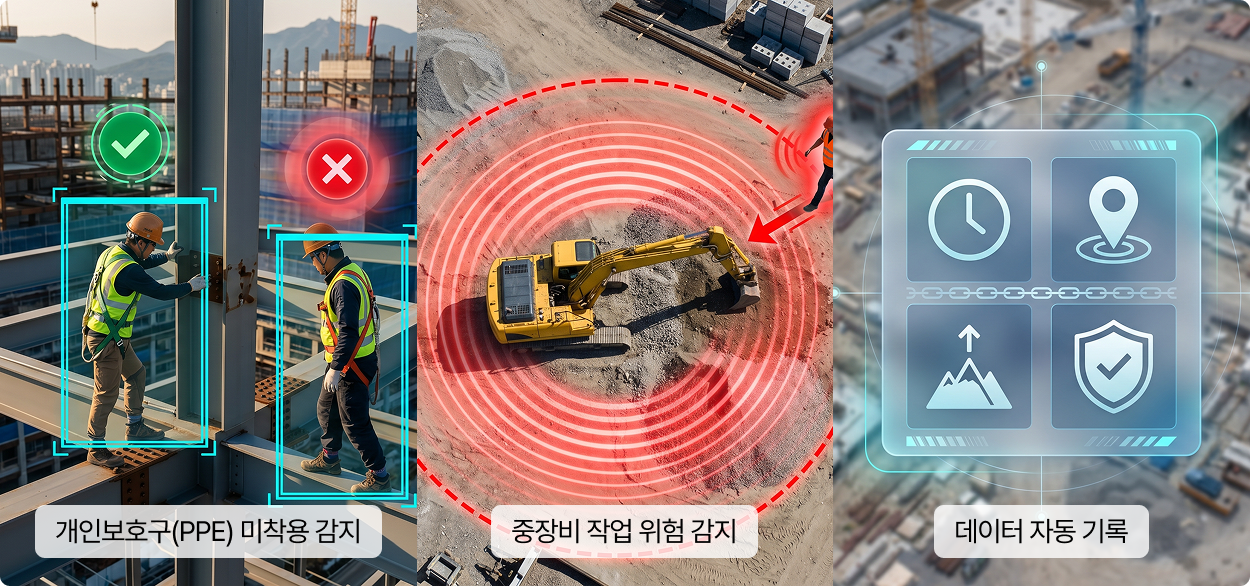
AI-based detection of missing personal protective equipment (PPE): The system must automatically detect from video when items such as hard hats and safety harnesses are not worn. This is the most frequent point flagged on site and a key criterion for whether preventive measures were in place.
Hazard detection within heavy equipment working radius: The system must be able to detect and warn in real time when a worker enters the working radius of equipment such as an excavator, in order to prevent fatal accidents like being caught or struck.
Automatic data recording and metadata storage: To prove what preventive measures were taken before an accident, the date, time, and exact coordinates at the time of inspection must be stored in a tamper-proof state, without anyone having to classify them manually.
Check 4. ROI Calculation — Watch Team Labor Cost vs. Dock + Platform TCO
When adopting a solution, the part people become most cautious about is, of course, the budget. Here it helps to compare the direct and indirect costs previously incurred with the total cost of ownership (TCO) of the platform.
Cost structure of the watch team model: Operating existing manpower incurs direct labor costs (KRW 4–5 million per watch team member per month × number of people deployed × construction period). On top of this, you must factor in hidden costs such as the inability to operate 24 hours during nights and holidays, and blind spots in personnel coverage. In other words, it is a structure where you spend 100% on labor costs but can hardly guarantee 100% safety coverage.
Cost structure of the Dock + platform model: This consists of the initial equipment adoption cost (Dock equipment + installation) and a monthly platform license. Because it repeats automated flights 365 days a year according to a schedule, no additional operating personnel are needed.
How to judge the break-even point: Annual watch team labor cost ≥ Annual Dock + platform TCO. If this inequality holds, there is no reason to hesitate. Moreover, drone data can be used in many ways—not only for safety monitoring but also for earthwork volume calculation, drawing comparison, and automating various reports—so with the cost of a single platform you can lighten multiple on-site tasks and experience an overwhelming ROI (return on investment).
Check 5. Data Security and Legal Evidentiary Value
Safety data is a sensitive corporate asset and, going forward, an important legal shield.
Cloud access rights: You need to confirm that viewing rights among the headquarters, sites, and partner companies are securely separated and controlled.
Security certification: You should check whether the provider holds accredited certification at a level that can pass the demanding in-house security reviews of large construction firms.
Long-term storage reliability: For handling disputes and defects, you must review whether time-series data is safely preserved over the long term without loss or tampering.
Meissa can solve all of these for you.
If you try to solve these 5 requirements by adopting multiple fragmented point solutions, your site's data ends up scattered and the practitioner's management points only increase. Flight automation, AI hazard detection, and turning data into an asset must run seamlessly on a "single platform" for true smart construction management to be complete. Meissa is the optimal answer that satisfies all of these requirements.
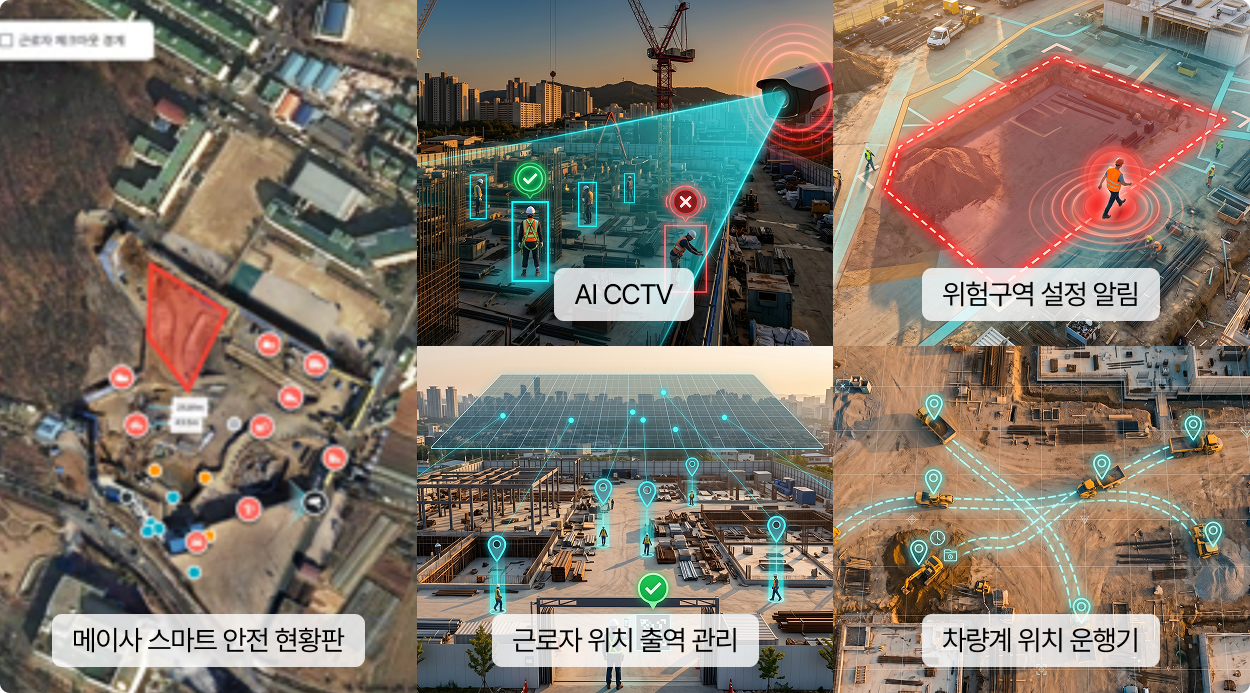
Smart Safety Dashboard | Integrates scattered safety data into a single screen to monitor the site without blind spots
AI CCTV | Cameras recognize hazardous situations on their own and immediately alert managers
Danger Zone Alerts | Set danger zones on a digital map and automatically warn the moment someone enters
Worker Location and Attendance Management | Prevents labor-cost settlement disputes with gap-free attendance data and grasps on-site personnel in real time
Vehicle Location Tracking | Tracks the location and movement paths of every vehicle on site in real time
Currently, top-tier domestic construction firms such as Shinsegae E&C, DL E&C, Woomi Construction, and HDC Hyundai Development Company have adopted Meissa as a company-wide standard to control on-site uncertainty, and 8 of Korea's top 10 construction firms are innovating their work through the Meissa platform.
Start the digital transformation that protects both on-site safety and your practitioners' time to head home—most reliably, with Meissa, right now.
Smart Construction Made Easy! Request a Meissa Demo.