

"Can our golf course also run course management with AI?"
This year, more golf course owners and operations teams than ever are asking this question. Labor costs keep rising, climate impacts are making course management expenses harder to predict, and visitor numbers are stagnating or declining — all at once. Revenue stays largely flat while operating costs climb, locking in a structure where the old playbook no longer holds up.
In this kind of structure, even small inefficiencies pile up into significant costs over time. Issues that go unnoticed day to day can suddenly grow large enough to shake the entire profit model. That's why the conversation in the industry has shifted: it's no longer about cutting costs — it's about redesigning the way operations work from the ground up.
This article looks at that shift through three lenses — ① why course management automation should be seen as 'infrastructure management,' not a 'cost,' ② why only some golf courses can actually 'explain' their operations, and ③ why now is a moment that's hard to put off.
💡What this article covers
The future of course management has already been set. From operations where people run around and endure with experience, repetitive tasks are being handed over to automation, and people are moving to operations where people focus on “judgment.”
The key to this transition is not equipment. As automation increases, the “judgment criteria” that determine what, when, where, and why to manage become more important. This is because as equipment, outsourcing, and manpower increase, the deviation in results increases without standards.
So what we need now is not a few automation tools, but an operating system that can run automation. What is that foundation Turf Health's operational data — An operational foundation where states, actions, and results are accumulated over time, making decisions based on comparison and basis rather than memory and estimationThis is it. Without it, even if automation increases, operations will revert back to a structure that relies on individual experience.
Asiana CC's 30% reduction in pesticides and 50% reduction in working hours is not an indicator of “money saved.” It's proof that even at the same site, golf courses that roll on an operating system and golf courses that don't already operate on a different baseline.
Automation changes “hands,” and operational data changes “judgment.”
The question is not “how much does it cost,” but “is our golf course running on an operating system?”
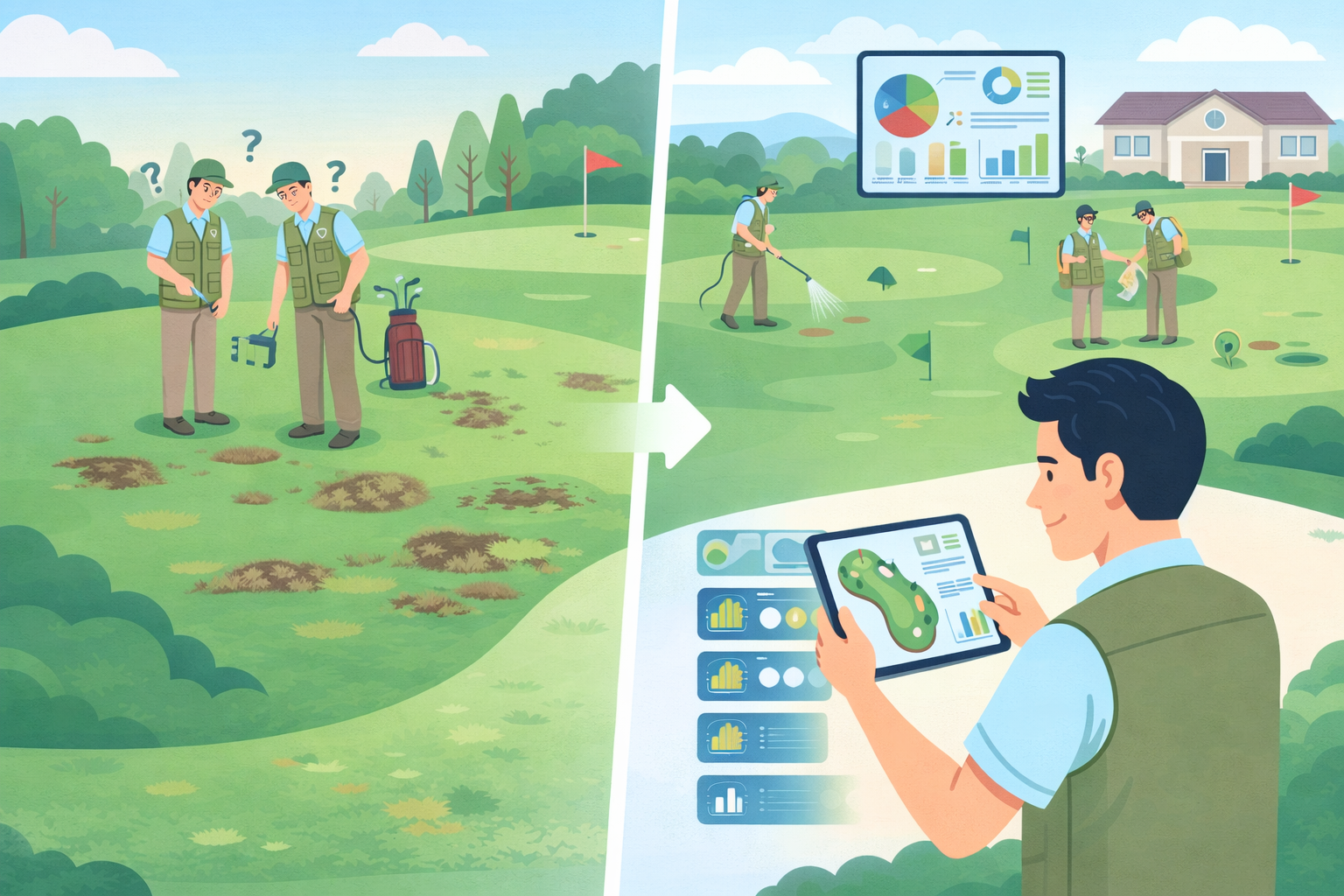
Even in the same environment, some golf courses can explain cost structures and performance, and others cannot. This difference is not a matter of technology How operations are being recordedIt happens at
Many golf courses explain increased costs as external factors. The effects of weather and the environment certainly exist, but it is difficult to structurally explain what affected them and how much. On the other hand, some golf courses record course conditions (current grass and soil conditions), actions (when, what, and why), and results (changes created by actions) in a single flow. Explain with data what decisions were made and what changes occurred as a result You can do it.
Past records were close to reporting texts. It focuses on work journals, settlement reports, and post-mortem briefings. Now the same record Operational data with cumulative status—action—resultsIt must be piled up with This difference goes beyond internal efficiency and leads to external evaluations. Membership values, collaboration opportunities, ESG disclosure, and operational reliability all depend on how clearly operations can be explained. This difference is even greater, especially when running multiple golf courses. Without standards, comparisons are impossible, and without comparison, improvements are difficult.
The most frequently overlooked risk in operations is not people historyIt's in If a specific person leaves, the workforce can be refilled, but the judgment criteria and operating context that have been built up over time cannot be easily restored. As soon as an outsourced course manager leaves the company or an experienced team leader leaves the company, the entire evidence for years of “why this measure was taken at this time” disappears. It will take at least 1 to 2 seasons for the new team to re-grasp the same situation, The owner is solely responsible for the expenses for that period.
This problem becomes more apparent over time. In a structure where operations rely on individual experience, no records are left, and without records, the same problems are repeated. In contrast, in a structure where data and records are accumulated, cause and effect are linked, and operations become increasingly stable. The difference between the two structures widens over time.
📎 Learn how to manage courses consistently through AI
This change isn't limited to just a few cases. There are already golf courses in Japan that are changing the way they operate.
Route 52CC and Flamingo CC do not report course status after the event Based on pre-diagnosisThe operation is being changed to It is a structure that objectively checks course status using data collected based on drones and determines what actions to take in advance.
Meisa Green is a golf course management data platform that supports this flow. By accumulating status—action—results on a single axis, the owner and management team can directly check the course status without going through a course management team report. The biggest change in this process is that operations are moving away from a structure that relies on individual experience. Operations continue based on data and records rather than the judgment of a specific person in charge. Operation is moving from the realm of “management” to the area of “decision making.”
📎See DX examples of leading golf courses
At the end of the day, the most important question in this article is one.
“Can we guarantee the consistency of judgment criteria even if a specific person in charge of our golf course disappears?”
If you can't answer “yes” to this question, then it's correct to assume that the costs when that gap occurs are already planned. Automated operation of golf course management is no longer a matter of choice, but a decision on how to take the operating structure. The future cost structure will vary depending on whether you keep the current way or switch to an explainable structure.