
A look at recent construction industry news shows that interest in adopting AI technology is rising rapidly. From on-site safety management to quality inspection and paperwork, automation is driving innovation across every area of the construction site.
Meissa, too, has been advancing a variety of features to improve work efficiency, including the automatic generation of photo-based site reports. Today, focusing especially on AI technology and automation solutions, we introduce the latest trends in the construction industry along with the innovative technologies Meissa is currently developing.

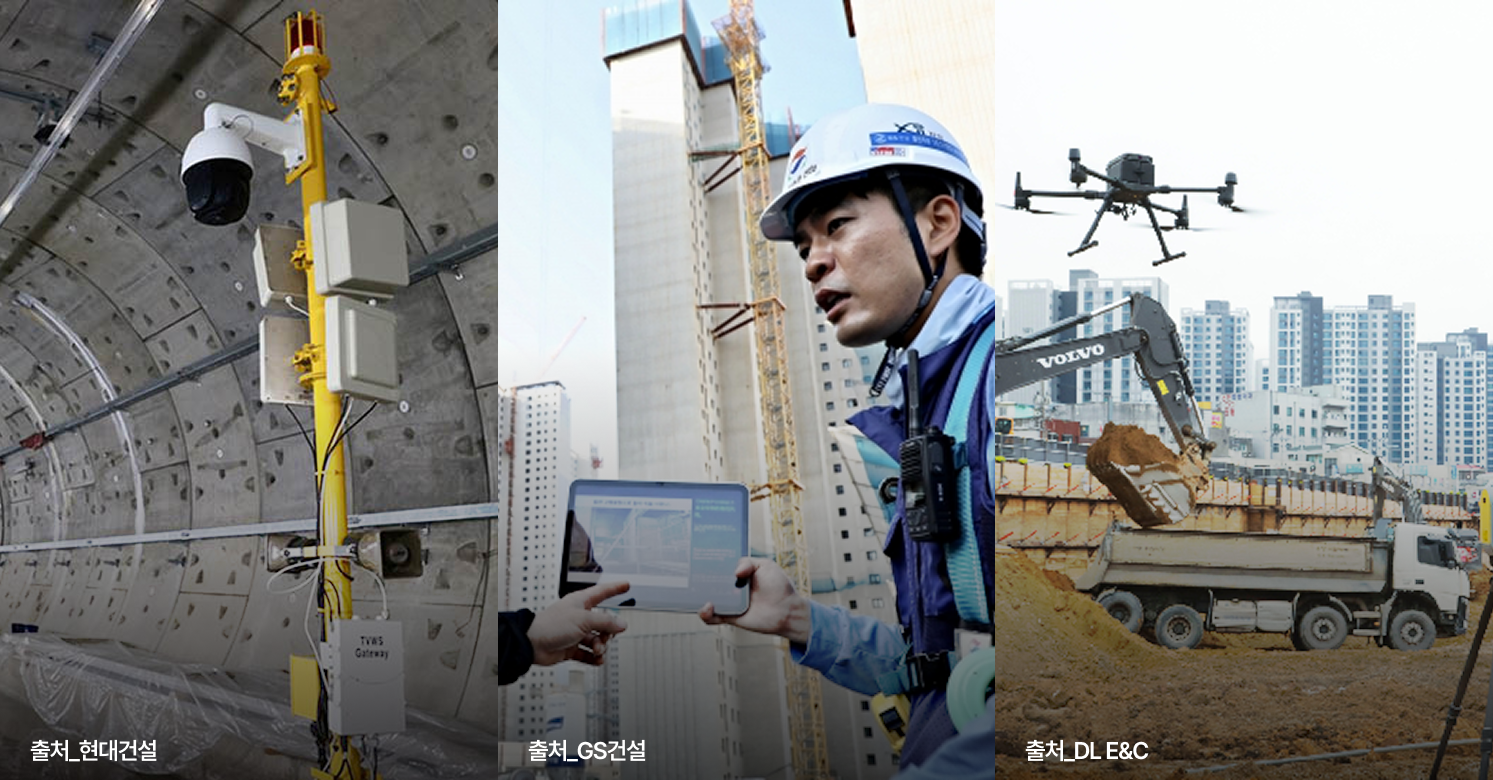
Hyundai E&C has built an integrated safety management system that combines AI CCTV and IoT sensors. It detects situations such as failure to wear a hard hat or dangerous proximity to equipment in real time, and in tunnel construction, its TVWS wireless-network-based 'HITTS' system integrates the management of CCTV, hazardous-gas sensors, and worker location tracking. In addition, through the introduction of AR smart glasses and the concrete strength prediction system 'QCON', it has greatly improved the accuracy and efficiency of quality management.
GS E&C is drawing attention with site-tailored AI solutions. 'Xi Voice' is a real-time voice translation and training system for foreign workers, while 'Xi Book' uses generative AI to search and summarize more than 5,000 pages of specifications and regulatory documents, providing accompanying YouTube videos and images as well.
DL E&C has introduced a system that automatically detects cracks and defects through drone image analysis. By building an integrated management system that applies AI from the design stage through defect inspection, it is setting a new standard for quality management. Lotte E&C became the first in the industry to apply AI image analysis technology on-site. By analyzing action-cam and CCTV footage to identify safety hazards, the system has greatly increased the efficiency of on-site supervision.
%201.png)
First, let us introduce the automation technology already in place. Meissa's GCP automatic recommendation system is a feature in which, when a user clicks a single GCP, the AI finds similarities among the surrounding photos and automatically identifies and recommends the same GCP location point in the other photos.
Precise GCP work is essential for tasks where accurate location information matters, such as drone surveying or earthwork volume calculation. As explained in a previous blog post, just like a CP (control point) that serves as a reference point during surveying, a GCP plays a crucial role in precisely matching the coordinates in drone photos to the actual ground coordinates.
To use GCPs in analysis, a post-processing step is needed to locate and mark the GCP points in the photos taken by the drone. To improve analysis accuracy, we recommend marking the same point across at least four photos for each GCP. Meissa's GCP automatic recommendation system makes this task easier.
The user clicks a GCP location once in a photo, and the AI automatically finds and recommends the same point in the remaining photos. With this feature, you can complete GCP marking more quickly and conveniently while simultaneously improving analysis accuracy.
%201.png)
This is a system that automatically verifies the accuracy of pile construction, which is critical in foundation work. It can be described as an AI-based, site-specialized system that analyzes the characteristics of special objects (e.g., piles) and leverages SAM (Segment Anything Model).
Pile work is structurally a core load-bearing element, so it must be constructed at the exact location and in the exact dimensions. However, because the process is handled by subcontractors, cases arise where the construction differs from the design, and since the process advances quickly, after-the-fact verification has been difficult.
Meissa's pile detection system automatically detects piles in orthophotos and measures the degree of eccentricity by comparing them with the design drawings. It automatically identifies outliers that fall outside the normal range and, based on this, provides an integrated solution that even generates reports automatically.
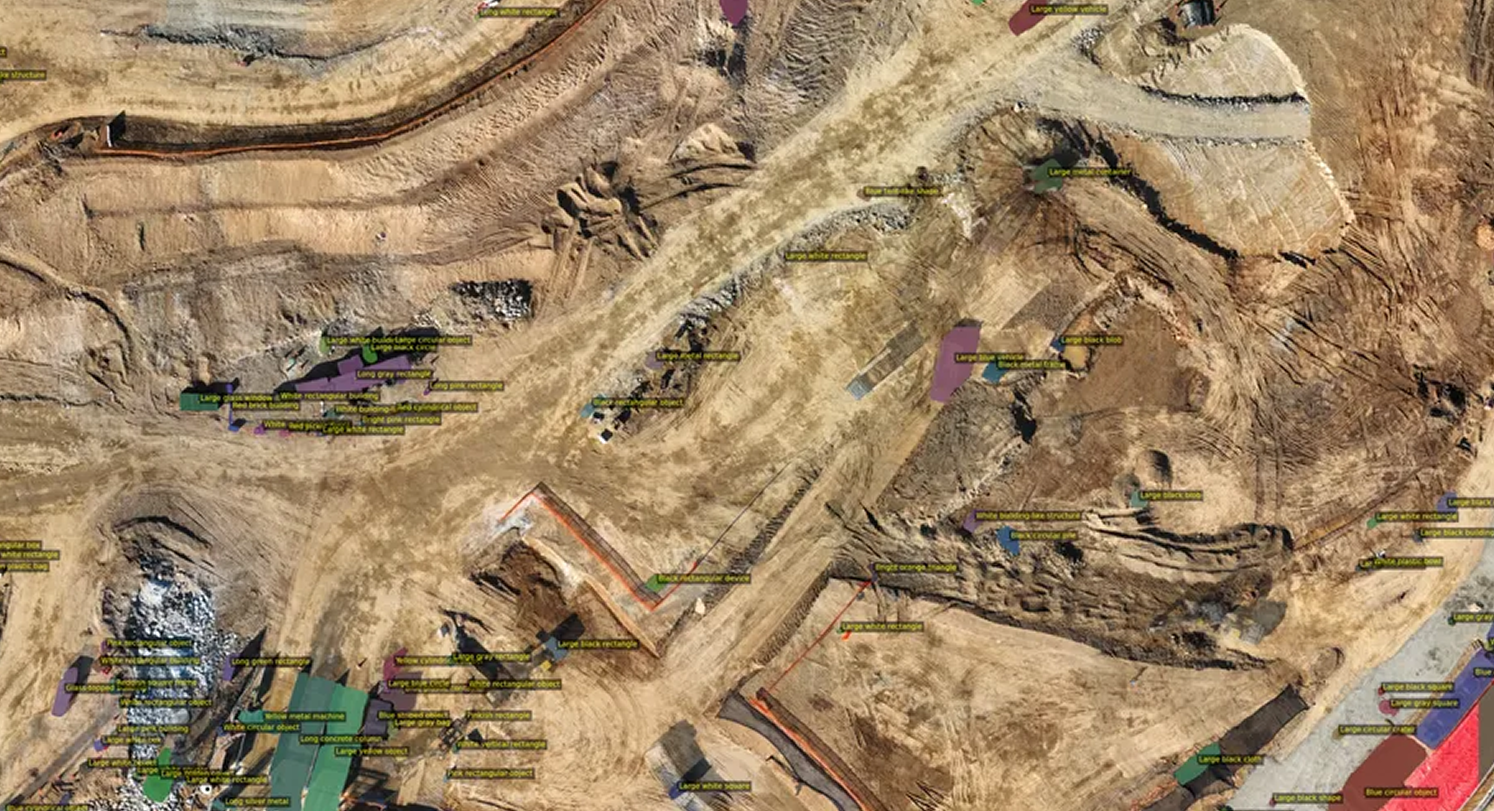
Meissa's DTM automatic eraser system is a feature that analyzes drone data to identify objects that are not ground and recommends the areas to be removed.
As explained in the previous post 'The volume calculation process using a drone platform', Meissa's volume calculation feature is computed by comparing the planned elevation with the current elevation. The current elevation used as the comparison baseline is the DSM data; for more accurate volume calculation, it is important to modify the DSM data and convert it into DTM data. Creating DTM data makes it possible to calculate the earthwork volume at a construction site while excluding unnecessary objects such as temporarily stockpiled soil or heavy equipment, yielding an accurate volume of the bare ground surface alone.
The key to DTM creation is accurately detecting the ground areas. To precisely capture only the terrain, all non-ground objects must be found and removed. That is why Meissa developed a model that uses SAM (Segment Anything Model) and VLM (Vision-Language Model) to detect objects at a construction site that are unnecessary for DTM creation.
While it is possible to fully automate object removal and provide only the finished DTM, from the customers' perspective there is a concern: "Can this data really be trusted?" Especially at construction sites where volume calculation is highly sensitive, there is bound to be significant worry about "what if the ground itself is removed by mistake?" In this context, Meissa adopted a recommendation approach. When the AI recommends "erase this area," the user makes the final choice about what to erase—securing both accuracy and reliability at once.
The adoption of AI technology in the construction industry is now a necessity rather than a choice. From improving on-site safety to quality management and greater work efficiency, AI is creating value across every area of the construction site. Meissa is focused on developing AI solutions that fit the real needs of construction sites, beyond mere automation. Rather than full automation, we are securing both reliability and efficiency through a 'smart assistant' approach in which human judgment and AI intelligence work in harmony.
Going forward, Meissa will continue to lead the digital transformation of construction sites and do its utmost to build a safer and more efficient smart-construction environment. If you have any questions about this, please feel free to leave your thoughts through our contact page.

