
Hyundai E&C and Meissa have been selected for the "AX Sprint," a national AI project with a total budget of approximately 4 billion KRW. This structure features a leading domestic construction company acting as the demand-side partner for a construction AI project that the government has officially recognized as ready for commercialization. Moving past the question of whether construction AI is even feasible, it is a signal that we have entered the stage of"who will use it first and how."
So, where are major construction companies actually using AI today, and what step forward is this project trying to take within that trend? This article explores the background, and the stories shared directly by each construction company will continue at the August 5th (Wed) NEXTCON Meissa Spatial AI Conference.

AX Sprint is the largest cross-ministerial AI transformation (AX) project, jointly promoted by 11 government departments. A total of 754 billion KRW is being invested across 246 projects, and as the name suggests, the focus is not on "research," but on the commercialization of AI productsthat are on the verge of market launch.
This is what makes this selection significant. For a long time, the key question for construction AI has always been, "The technology exists, but is it actually used on-site?" AX Sprint is a project where the government has provided budget-backed answers to that very question. Furthermore, each project is The companies that will actually use the technology must participate as well, which creates a structure where they can be listed, effectively serving as an extra filter to ensure the product is actually marketable.
Among the projects selected in the land and transport sector is the 'Commercialization of an AI Platform for Construction Process and Safety Management.' The total project budget is approximately 4 billion KRW, with a 12-month duration starting in July 2026. The lead organization is the spatial AI company Meissa, joined by Hyundai E&C as the participating user company. The fact that 'construction safety' was chosen for commercialization support among countless AI application fields, and that a leading domestic construction firm is participating as the user, is proof that the industry has begun to view construction safety AI not as an 'experimental concept for the future,' but as a 'commercial reality for today.'
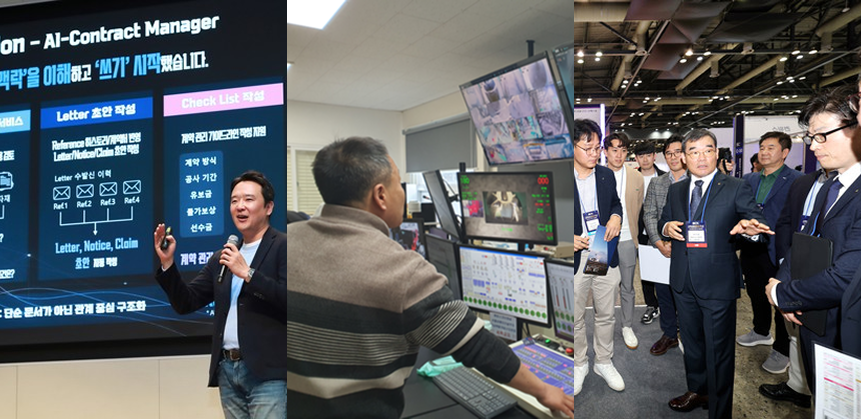
Looking at the moves made by major domestic construction companies over the past year, AI has already moved past the 'review' stage and into the 'application' phase. However, the focus varies slightly from company to company. It can be broadly divided into two categories.
One is the intelligence of office operations and decision-making. Samsung C&T has declared its goal to become an 'AI-native construction company' by transitioning all operations to AI by 2028,and has partnered with AWS to introduce three types of AI agents responsible for bid analysis, contract risk management, and integrated site data analysis. GS E&C became the first construction company to adopt ChatGPT Enterpriseto expand its internal usage culture, while Daewoo E&C has developed 'Barodap AI,' an in-house document analysis AI that accelerates the review of overseas bids and contracts.
The other is the intelligence of sites and safety. POSCO E&C received the grand prize at the Ministry of Land, Infrastructure and Transport's Smart Construction Challenge for its technology that uses AI to adjust ready-mixed concrete mixtures in real time and predict compressive strength,and DL E&C is using drone-based digital twins to manage processes, quality, and safety in an integrated manner. Hyundai E&C, in particular, has been aggressively expanding its collaboration with startups in the safety sector. By attaching AI cameras to excavators to warn of worker proximity and using 360-degree video to detect equipment hazards, and by identifying 48 safety startups in 2025 alone, they have consistently verified on-site safety technologies through their 'H-Safe' open innovation program.
A common thread emerges here. Most AI in the field of site safety has reached the point of 'detecting and alerting' to risks. While this is a significant step forward, it also leaves us with the next question: Should the 'judgment, action, and verification' following detection still be left to humans?
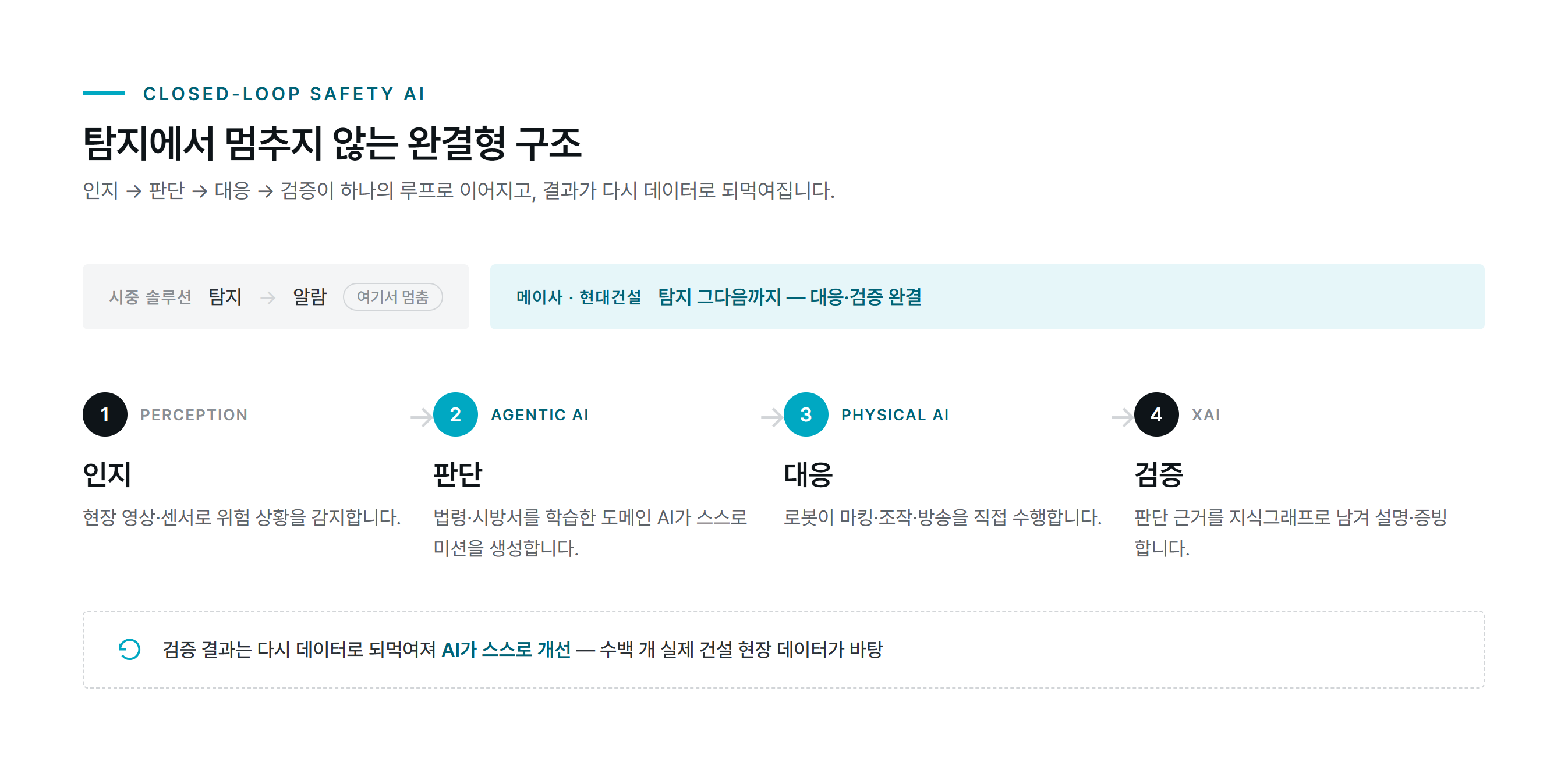
The difference lies in 'how far the AI goes.' As we have seen, most safety solutions on the market stop at 'detection' and 'alerting.' Once a risk is identified and a notification is sent, the subsequent judgment, instruction, and verification fall back on humans. This project, in which Hyundai E&C participated as a demand company, aims precisely at what happens 'after detection.'
What this project aims for is A complete, end-to-end structure of 'Perception → Judgment → Response → Verification'. A domain-specific AI, trained on construction laws and specifications, autonomously assesses situations to create missions (Agentic AI). Robots then perform marking, manipulation, and broadcasting (Physical AI), and the results are fed back as data for self-improvement. This is all built upon data accumulated from hundreds of actual construction sites.
There is one more point worth noting here. 'Explainable AI (XAI)' that provides the rationale behind decisions. By mapping construction laws into a knowledge graph, the structure enables the AI to explain "why it made that decision." Since safety measures require proof of rationale in the event of an accident, this is a feature that headquarters departments responsible for technical reviews should pay particular attention to.
The reason why this story is important for other construction companieslies in the roadmap. Maysa plans to pursue registration as an innovative product with the Public Procurement Service following field demonstrations at Hyundai E&C sites and official performance evaluations by the Korea Institute of Civil Engineering and Building Technology (KICT). Once the foundation of large-scale site validation, official agency assessment, and procurement registration is established, the burden of internal approval and technical review for companies following suit will be significantly reduced. The trend of construction safety AI moving beyond 'detection' to 'completion,' and from 'experiment' to 'standard' is clear—though how this change takes root at each site ultimately depends on the judgment and preparation of each construction company.
.png)
If that covers 'what is happening right now,' only one question remains. "So, how are other companies keeping pace with this trend?"
An event will be held in August where you can hear the answers directly from the parties involved. On Wednesday, August 5th, Maysa will host the 'Spatial AI Conference' at KOREA BUILD. Together with those who participated in this AX Sprint, Hyundai E&Cwill share the progress of this project and collaboration case studies, and Lotte E&CWe will present real-world case studies that integrate drones, AI, BIM, and cloud technology on-site. If you have been curious about how other companies are applying construction AI, how they collaborate with startups, and how these various technologies work together in the field, please join us at this conference.
.png)

