
Managing a site with a drone platform sounds promising, but does it really deliver? If you have ever considered adopting one, you have probably also wondered, "Do we really need to add this to a site that is already running smoothly?"
To get straight to the point: yes, it clearly delivers. But the benefit is not something a single flight produces, it is a benefit that grows as your data accumulates. There is one key to understanding this: construction site management is ultimately 'operations run on spatial data.' Design, construction, and earthwork volume all happen in space, so site management, too, is most accurate when it is based on spatial data. And a drone is the tool that puts that spatial data in your hands the fastest and most precisely.
In this article, we will look at how a drone solution like Meissa creates real value on actual sites, from three perspectives: cost, time, and trust.

%201.png)
On civil engineering sites, the primary contractor surveys, and then the subcontractor surveys again. The same work ends up costing time and money twice. With drones, instead of going through multiple rounds of surveying, spanning the primary contractor, subcontractors, supervisors, and submissions to the client, you can work from a single set of reference data. When you calculate earthwork volume from drone data, you can manage increases and decreases as 3D spatial data, so communication between companies also becomes clear on a shared basis.
This value is evident in everyday operations, but it grows even greater in unexpected moments. When you run multiple sites, one or two are bound to run into unforeseen issues, and for a contractor, a single issue can be the decisive factor that determines a project's profit. What matters is that the data you need in that moment cannot be created after the fact. Only data you have steadily accumulated beforehand can serve as your reference. That is why the cost benefit shows up not just on individual sites, but also from the perspective of company-wide risk management at headquarters.
%201.png)
Even for the same issue, everyone views it from a different vantage point. When someone says "there is a problem in Section A," one person looks at the bottom while another looks at the top. So in the end, the cycle of going to the site in person to check, holding meetings, and reporting back keeps repeating.
Basing this on drone data shortens the process. Because everyone plans and decides while looking at the same screen, decisions about a designated section are made accurately and quickly. The larger the site and the farther the civil engineering site is from the office, the more strongly you will feel this value of cutting down round-trip travel time.
%201.png)
Construction runs for one, two, three years. If you rely on photos and memory alone, the unrecorded sections are the first to disappear, and memory inevitably fades over time. If you record with drone spatial data, the site as it looked at a specific point in time remains intact, enabling objective explanation and evidence. Because a site, once past, can never be brought back, the very act of accumulating records makes them an asset. And when all the data is stored in the cloud, putting it to use becomes even easier. There is no need to go back to the office computer to find files, you can check and provide evidence right there on the spot, whether on your phone or a field tablet.
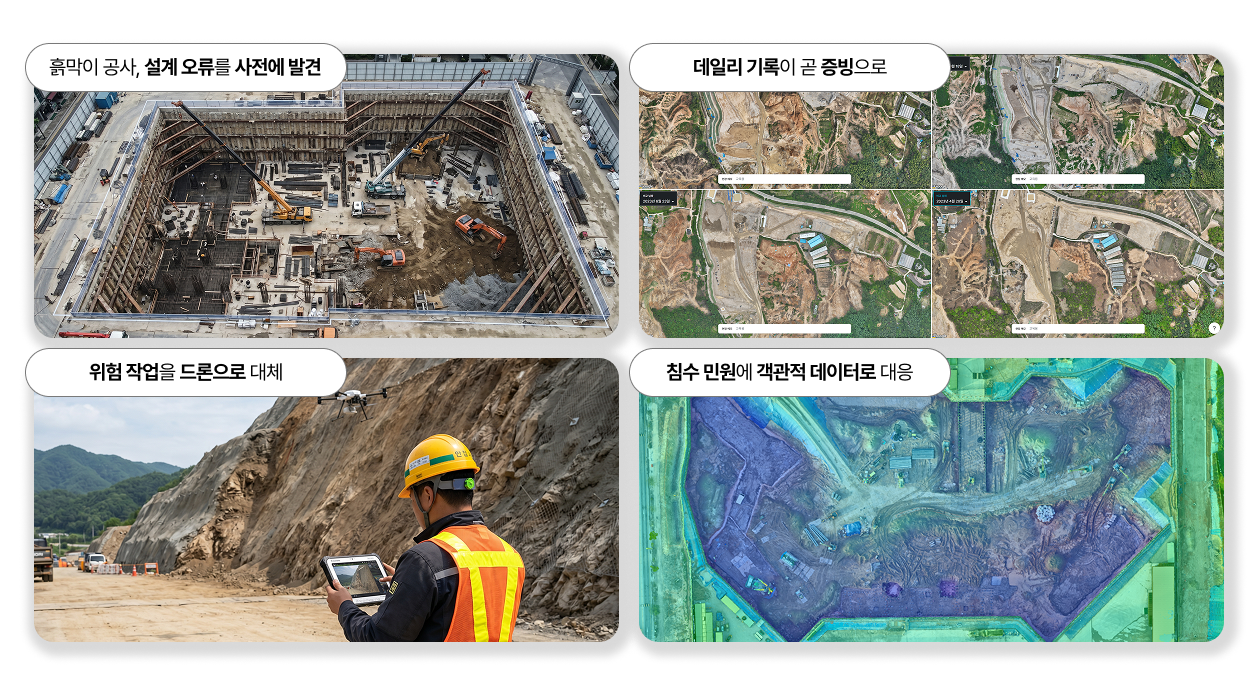
It may sound abstract in words alone, but the benefits become far clearer on actual sites.
The common thread across the four cases is clear: spatial data accumulated steadily served as the basis for everyday operations and, in decisive moments, became the most reliable evidence.
The recent direction of the industry places even more weight on this perspective. The Construction & Economy Research Institute of Korea (CERIK) emphasized that, as the center of gravity in AI competition shifts from 'algorithms' to 'data,' we should view the data generated every day on construction sites not as a mere by-product, but as a core asset that will determine future competitiveness. It points out that a great deal of site data is used only for verification when an accident or dispute arises, and fails to accumulate into greater value. As an efficient way to secure high-quality data, the institute proposed "a structure in which data accumulates naturally in the course of doing the work, rather than incurring separate collection costs."
And the conclusion is clear: "The competitiveness of the construction industry in the AI era depends less on how much equipment you own than on how much high-quality site data you secure and put to use." Spatial data created with drones is precisely that asset. Beyond preventing a single issue, accumulating every moment of the site as objective data becomes, in itself, the company's competitive edge.
The value of a drone solution is completed not by a single flight, but by steady accumulation. In the end, the better a site builds up its data, the more clearly it reaps those benefits.
That is why Meissa does not stop at simply providing drone data. By automating collection with an unmanned drone station and making Ground Control Point (GCP) work easy with RTK, we create a structure in which data accumulates naturally in the course of the work, with no added burden. We also set up an environment for communicating and deciding based on spatial data so that the site is genuinely 'operated,' and even after adoption, a dedicated account manager stays alongside you with regular training and on-site checkups.
The experience of those who have watched over sites for 20 or 30 years is invaluable. When daily-accumulated spatial data and AI are added to it, and that experience is organized into objective evidence, site decision-making will become one step more solid.
If you are curious about how to build your site's data into an asset, reach out anytime via the Contact button. Meissa will help you manage the variables of your site together.
📺 This article was reconstructed based on 'The Value of Drone Solutions on Construction Sites.' If you would like more detail, you can watch the presentation video

