
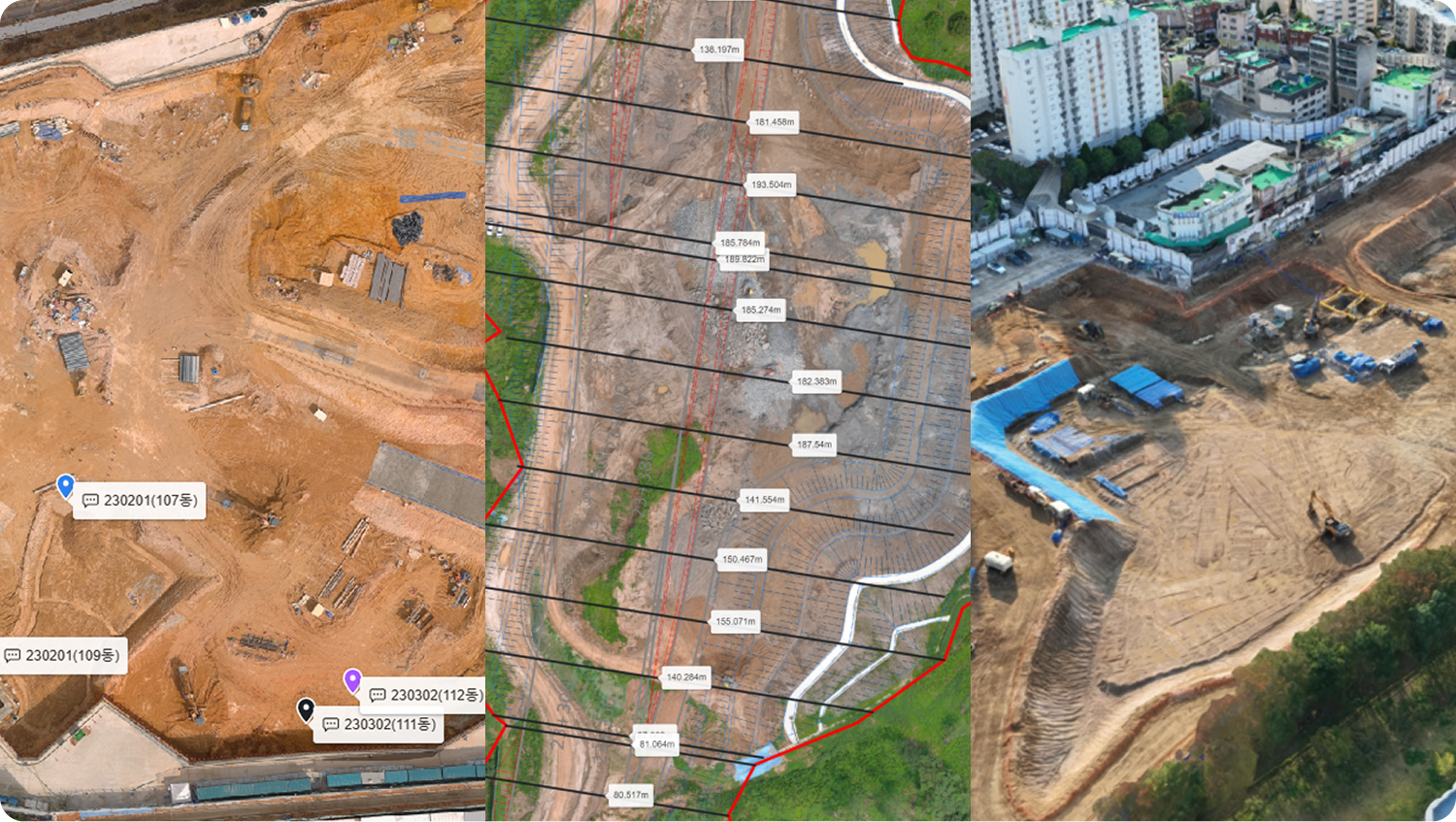
%201.png)
The recent '2026 Hyper E&C with Smart Construction' event, held by Daewoo E&C at its headquarters, sent an important message to the construction industry: the operation of a drone monitoring system that oversees multiple sites simultaneously, and a declaration to expand the field deployment of an LL (Lessons Learned) AI agent that learns from past successes and failures.
This signals that drones and spatial data—once regarded by field staff as little more than 'surveying convenience tools'—have now been elevated to 'performance-verification tools' that CEOs and executives oversee directly. So why are major builders now racing to invest in spatial data platforms? Drawing on real-world use cases from Korea's leading construction firms as of 2026, we examine the clear investment rationale and the ROI (return on investment) behind the trend.

In the past, adopting smart devices was entirely the site's own choice. Today, however, smart construction platforms are treated as a top-priority agenda at the headquarters level. Amid the strengthened Serious Accidents Punishment Act and mounting cost pressures, headquarters now needs 'eyes' to intuitively grasp and control dozens or even hundreds of sites.
Construction site management is now shifting away from reliance on subjective paperwork and individual experience toward operations grounded in objective 'spatial data' that align design, construction, and progress billing. As data accumulates over time, decision-making becomes more precise, and risk response evolves from after-the-fact cleanup into 'proactive prevention.'
As of 2026, leading major construction firms are embedding the platform into their operations in the following ways.

When adopting smart construction, the shared concern of both executives and practitioners is: "Will it deliver definite cost savings and time reductions?" On-site, immediate benefits are being realized mainly in the following three areas.
The most powerful yet often overlooked benefit of adopting the platform is precisely the conversion of past data into assets. A site changes without pause, and once the person in charge changes or a process is covered over, it becomes difficult to prove past construction conditions.
Site managers at major builders emphasize that Meissa's record data, accumulated over time, serves as powerful, objective evidence in any future disputes or defect repairs. Construction methods and know-how that once depended on individual intuition and memory now remain fully intact as data on the platform, becoming a 'company asset' for the next site and a source of hints for objective decision-making.
The spatial data of a construction site compounds in value over time. Accumulated time-series data goes beyond a mere record of the past to become the surest 'digital shield' for predicting processes and defending against risk.
The majority of Korea's Top 10 major construction firms are already redefining the standard of site management through Meissa.
If it all still feels vague, start by objectively visualizing your own site's data and turning it into an asset. Meissa, the complete platform connecting headquarters and the field, will be right there with you.

